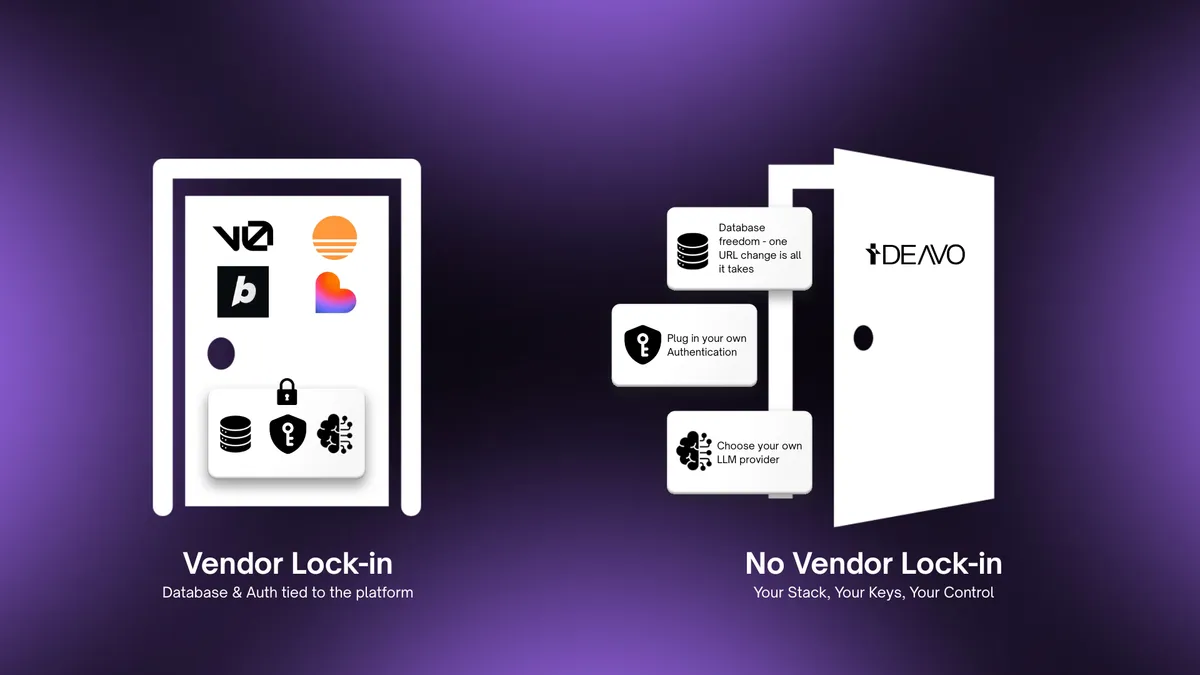
Ideavo was built around one belief: if you’re building something real, you shouldn’t be forced into someone else’s stack.
When the prototype stops being “just a prototype”
Most build-fast platforms feel magical in week one. You ship a prototype, share it, and get early signals. Everything feels smooth - because you’re still inside the defaults.
Then reality kicks in. A customer asks for a feature that needs a different database pattern. Costs climb because your model choices are limited. And you realize the stack you picked on day one isn’t the stack your product needs on day thirty.
That’s when the prototype starts feeling less like momentum - and more like a trap.
How closed architecture quietly breaks momentum
Closed architecture rarely fails loudly. It fails gradually.
At first, you notice small friction: you can’t choose the right tool for the job. You’re pushed into whatever database, auth, or model the platform was designed around—even when your product clearly needs something else. When you try to change one core dependency, it isn’t a swap anymore; it becomes a rewrite. And as usage grows, your costs grow too, because you don’t control the economics - you inherit them.
Over time, that friction becomes a tax on every decision.
Why Ideavo is built on open architecture
We didn’t want to build a platform that’s “easy” only as long as you stay inside a box. We wanted something that stays flexible when your product becomes specific.
That’s why Ideavo is built on open architecture with BYOK - Bring Your Own Keys - for the three dependencies that decide your future: LLMs, databases, and authentication. Not “approved integrations.” Your actual keys. Your actual choices.
What this unlocks for you
Open architecture isn’t about having more options in a settings page. It’s about picking what fits.
Different products need different foundations. A data-heavy or data science app might need a database optimized for large-scale querying and reporting. A real-time app might demand low-latency reads and fast writes. A workflow product might prioritize consistency and transactions. When you’re allowed to choose what matches your app, the architecture supports the product instead of limiting it.
And the difference shows up in your costs too. When you can route work to models that are cheaper or more specialized for a task, you don’t get stuck paying one-size-fits-all pricing as usage grows. You get to optimize as you learn.
The simple promise
Requirements change. Teams learn. Products evolve. When that happens, your stack shouldn’t punish you for adapting.
Ideavo is built so you can build fast now - and stay flexible later.